
There are things you must never do,
not by day nor by night
not by sea nor by shore:
for example WAR.
Gianni Rodari
I thought of these words four years ago, on the 24th of February 2022.
To this day, war exists.
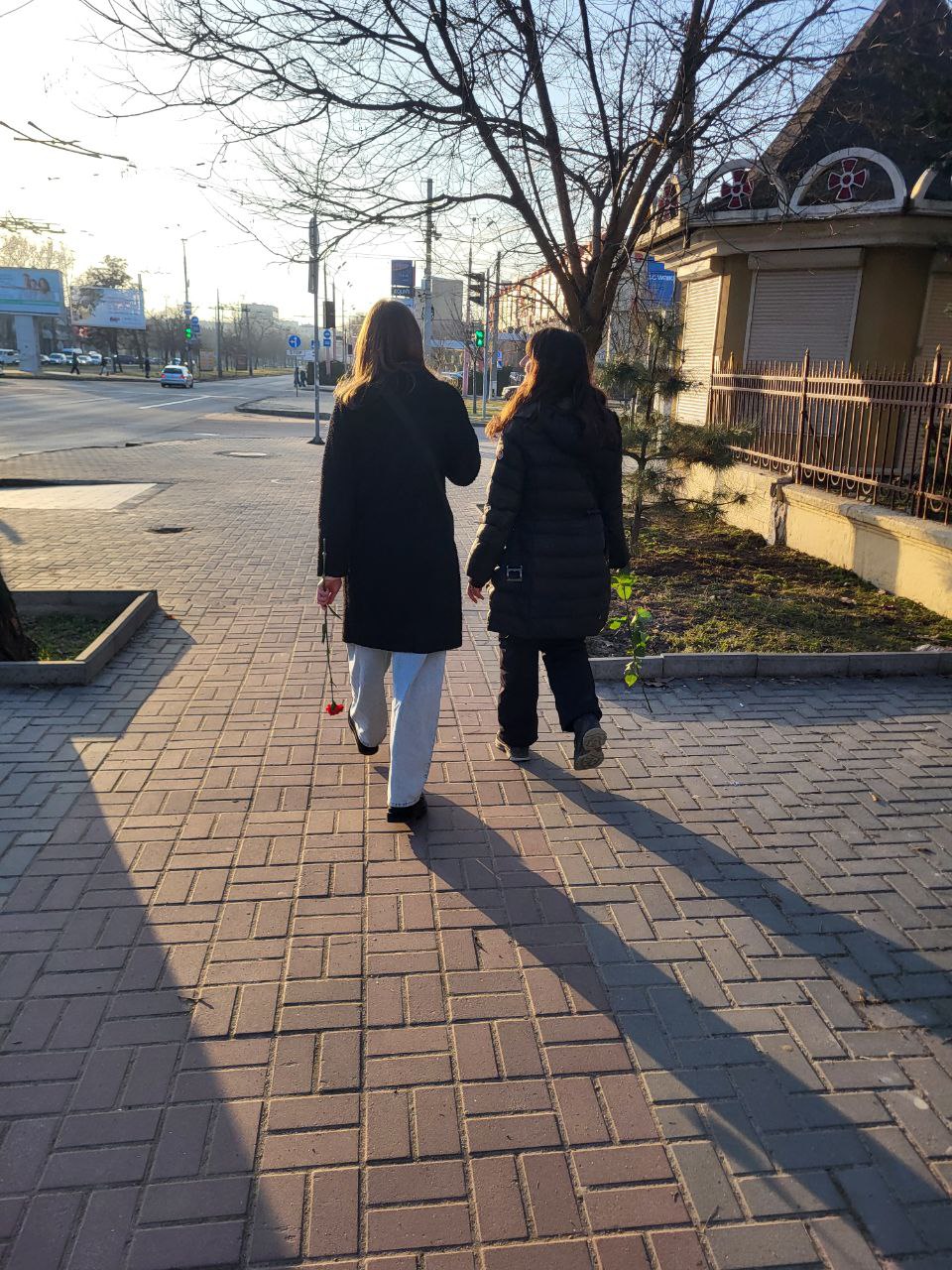
Unlocking your phone is enough: news of new frontlines, escalations, missiles, drones. A continuous quantity of violence that seems to overtake the world. Then you lock it again, and remember that in some places war is not a piece of news: it’s daily life. And just like that you find yourself in the centre of Mykolaïv, walking by open shops and people chatting amongst themselves. Then the syren rings out and the store’s clerks make you exit immediately.
Common procedure, safety measures. No dramatics, only a city that keeps on moving, while a metallic voice reminds us that war is there, always near. You live underground, in a shelter that has become a home to many. The people with which we share the day there ask us whether we ate, if we slept, what we had been doing. One of them, I., told us “You’ve become my nieces at this point”, while we talk and he tells us jokes. The quiet and concrete care of these people warms our hearts, and even in this underground shelter normalcy and affection make their way through. A few Sundays ago it was the first day of spring. We went out for a walk with M. and N. The warm sun, the sandwiches shared on a bench, a few light-hearted laughs. At the end, M. looked at us, and told us it had been one of the best days they’d had in a while, thanking us profusely. We had not done anything extraordinary. There is simplicity too, in the evenings passed chatting, smiling and eating chocolate: evenings when M. spontaneously opens the doors to their world.
How much life is in there! You find yourself then, living on one of the frontlines, at Kherson, where war is even closer. Drones fly over the city and fire on houses and civilians; the streets can be mined. And yet life goes on, filled with everyday gestures that become heroic. S. tells us their life, their weakness, pieces of themselves, with disarming sincerity. Then, during a quiet evening, pulls out a massive fish caught in the river near their house and cuts it in the kitchen. We laugh while we load the wood for those who don’t have heating or while we try to watch a movie, in that fake silence that we can’t manage to keep.
Between the work, the cold and the moments to relax, there’s a sincere and contagious joy. And it’s that moment that stays with you: when you get to Kherson and they tell you with a smile, “Welcome back home”. The rest of the world can blow up, but there, there is warmth, humanity, resilience. Saturday mornings we meet the children in the church building: we dance, play, and life fills the air. On Sundays we laugh, eat, spend some time together. Then there is mass: they sing, dance, pray. A few Sundays ago I thought a missile or a drone could have dropped on our heads any moment. And while I looked at them dance, sing and pray, I thought: how beautiful. They really are beautiful. Full of life in the middle of war. Full of light where death is everywhere. When you feel the gratitude and affection of these people, you understand that the real subversive act is not war. It’s human relationships, the quiet care, the shared life. Every question finds an answer: you are here for that humanity that does not give up, “like a phoenix rises from its ashes” (S. - Kherson). Yes, war should never be done. Neither at day, nor at night: neither at land, nor at sea. Yet those in power do it. I don’t go back for a lack of fear. I go back for the people that open their life to you, for the gestures that keep forging bonds, for the warmness left between the rubble, for the presence that keeps standing while facing war.
There is beauty in the world. And it’s right to fight for this. In this war that they are forced to live, they survive... with all the love they have.
Always. C.

 OPERAZIONE COLOMBA


