
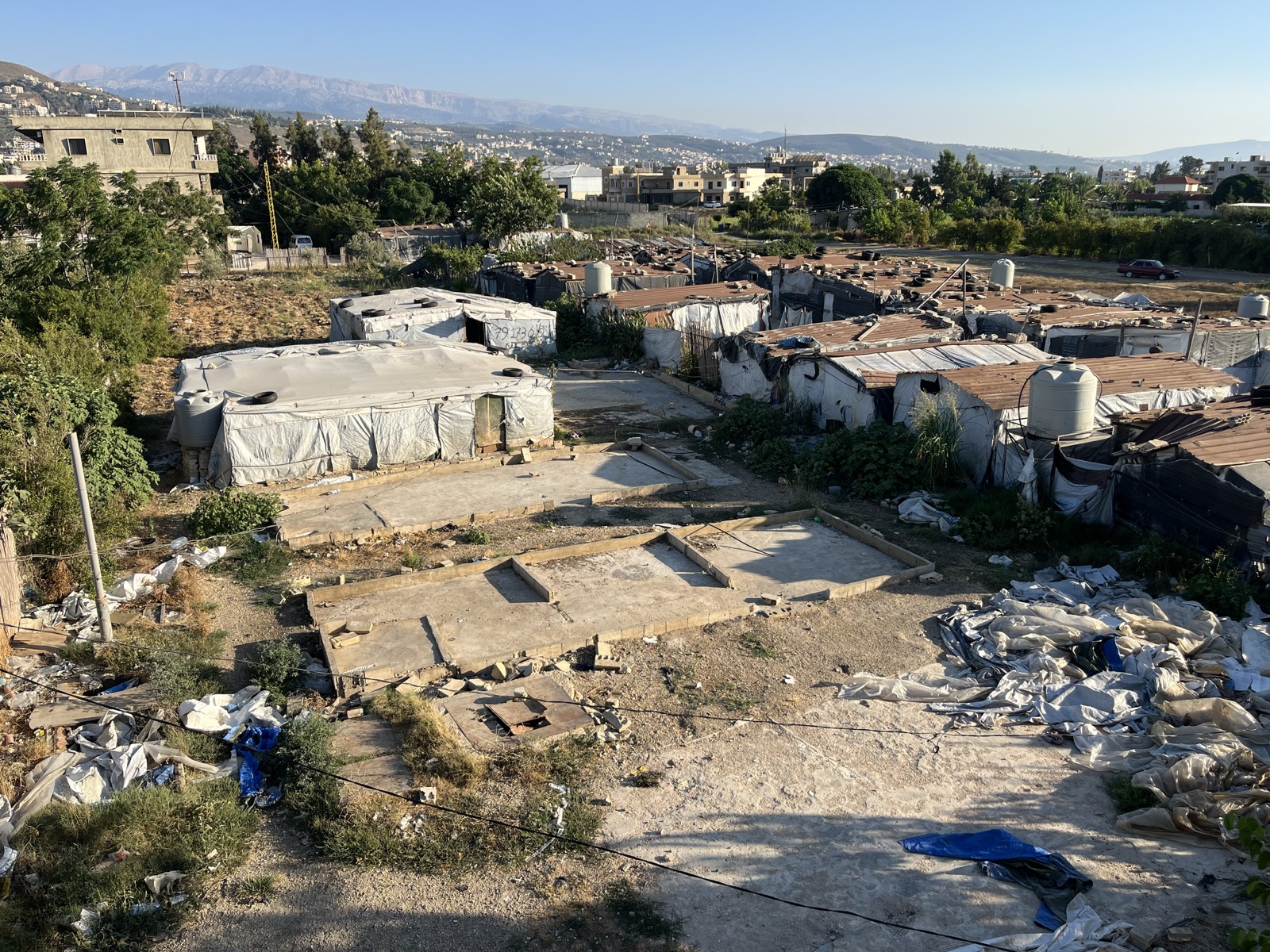
Carlo is on his way back from Syria. He is the last Operazione Colomba volunteer still in the area, and before catching his flight home, he stops in Lebanon.
He is in Akkar, the place where we spent around twelve years as Operazione Colomba. From there, he sends us a photograph: the one you see here. Just a few empty square metres.
“The tent is gone,” he writes.
And it is. All that remains is a rectangle of old concrete and dust. This is where the “doves” lived for years, alongside people fleeing the war in Syria. It is not a large piece of land, but it has witnessed an extraordinary amount of life, humanity, feeling and emotion.
We first set out towards Syria right at the beginning of the conflict.
We began with exploratory trips, trying to understand whether and how we could stand alongside those suffering the consequences of the war, and what kind of message of peace and nonviolence we might be able to bring. We soon realised that, especially in those early days, there were not many words to offer. What mattered instead were concrete gestures and acts of peace. Acts that, first and foremost, meant drawing close and accompanying people. Standing alongside them.
Because people, especially when they are facing extreme hardship, believe in what you do and in who you are - not in what you say.
And so we found ourselves in Lebanon, determined to be as close as possible to the people there: not simply near them, but right in their midst, sharing their lives as much as we could.
That is how we began: by pitching a tent right among those fleeing terror, among the poorest, among refugees. In one of the many makeshift camps, in a country that did not allow organised refugee camps to be established.
“This is no place for you to live,” they told us at the very beginning.
“If we can live here, then so can you,” we replied.
Many thought we were crazy. A few admired us. No one else did.
On our very first night, a storm tore our fragile tent from its pegs and filled it with water. We were taken in by one of their families. Perhaps there could have been no better way to begin.
When people ask us who the “doves” are, what the volunteers actually do, it is not easy to find the right words. The best descriptions have come from those who lived alongside us.
We were “the ones who walk”, because unlike all the other international actors working there, we travelled on foot or on the same “service” minibuses used by refugees and Lebanese people. We walked countless kilometres to visit people, stopping a thousand times along the way to say hello, and just as often accepting spontaneous invitations to sit down with them for tea or coffee.
After we had been living in the tent for some time, our neighbours began describing us to newcomers as “the ones who cry and laugh with them”.
And we did - so many times, both things, right to the very end.
They also described us as those who stayed with them “when it was cold and when it was hot”: because the tents became unbearably hot in summer, while in winter the damp cold seeped right through you. Only someone who had actually been there with them could understand what it meant to live that way.
One of the older women, a respected authority in the camp, wrote that “we had breathed life onto the embers of their hearts”, so that their humanity would not be extinguished. To her, we were “her best children”.
Perhaps the word that best describes us is simply this: “those who stand alongside”: Those who place themselves beside someone. Not in someone else’s place; not “above” them, giving orders, nor “below” them, taking orders. Not distant and detached, but neither merged with them nor absorbed into their lives. Simply alongside those who have chosen nonviolence, or those who are suffering injustice and violence.
We stand alongside people for as long as we possibly can.
For twelve years, we stood alongside those fleeing the Syrian conflict, on that small patch of Lebanese land that today is nothing but an empty stretch of dust.
The way we were there changed considerably over time, just as the injustices, pressures and forms of violence changed.
At first, people asked us to stay with them because they were afraid of the attacks taking place at the time. Our presence finally allowed them to sleep again.
We tried to build bridges between this large and desperate community and the local population that was often frightened and hostile towards them. We sought to create opportunities for people to meet and to build mutual trust.
Then we began accompanying Syrians who risked deportation at checkpoints because they were considered “irregular” residents. We travelled alongside them on buses so that they would not have to face police checks alone.
As time went by, our tent became many different things: a security presence during raids and night-time attacks on the refugee camp; a place where children could play; a meeting space for young people who had little access to cultural activities; and even a kind of health hub.
We “doves” became experts in clinics, injections and antibiotics, because being accompanied by us was often the only way people could access medical care. Together, we faced a number of health emergencies, from cholera to scabies.
We also became a crucial point of reference for those seeking to understand the situation on the ground - from the United Nations and NGOs to leading Italian and international journalists.
When we realised that standing alongside people also meant taking responsibility for the lack of safety and the absence of any prospects for the future, we tried to create openings towards that future.
We carried their voices and their call for justice, bringing a “Peace Proposal for Syria” with them to the Italian Parliament, the European Parliament and, eventually, the United Nations, as well as to the Pope and the Dalai Lama.
Their dream had always been to return home, to a safe and demilitarised place where they could live in freedom.
But the pressure and harshness of life in the camps became unbearable.
This was how the Humanitarian Corridors came into being and grew, and we played a key role in making them possible. We had to learn a great deal: how to stand alongside those who were leaving, but also those who remained behind, and those who would welcome them in Italy.
Because meeting one another and learning to accept one another is hard work, and good intentions alone are often not enough.
Many of us truly “adopted” families.
We were there when the revolution “erupted” in Lebanon, too, and we asked ourselves what it meant to stand alongside people then, while listening to what was happening in the streets and squares.
Then came COVID, and with it our forced and painful return to Italy. That was when we learned how to be present from a distance, following people’s lives in Lebanon through endless voice messages and improbable requests, often arriving at equally improbable hours.
As soon as it became possible, we went back for a new beginning, setting up a new tent in the same camp. During our absence, everything that had belonged to us had been given away to those who remained, and our “home” had taken on a new life.
We were alongside Syrian men and women when the regime fell, sharing their disbelief at what was happening. They were the first to ask us to accompany them once again - to their homes and back to their country. We tried. Little by little, our presence shifted from Lebanon to Syria. Some people found the courage to return to the ruins simply because we were there. “If you had not been with me, I would not have gone back.”
Eventually, we managed to establish ourselves in Syria. Once again, this meant starting from scratch: building bridges between different communities and turning our home into an open space where people could listen to one another’s wounds and meet across identities marked by mutual suspicion.
We arrived during the war. We stood alongside the Syrian people in the tents throughout the long years of exile, during their return home and through the first stages of reconstruction. Now we are stopping - at least for a while.
Our tent is gone, and the refugee camp itself has now been cleared. We leave while looking at this empty space, but also at everything that is being rebuilt: the houses going up in Syria, and the first moments of community life we have shared together, finally on their own land. Among them was a beautiful interfaith iftar* organised by us together with them - the first of its kind in the new Syria.
Looking at that photograph, at that piece of land that is now empty, one question naturally arises: What remains after all these years of standing alongside one another?
So many people have come and gone, both among the “doves” and in the refugee camp. Generation after generation of young men and women took their turn: people searching for themselves through encounters with others; searching for answers to their own need for justice; wanting to change the world; looking for hope; or simply curious to see where such an experience might lead them. And so many families passed through the camp, searching for a future and for a life of dignity. We experienced the extremes of human life there - from violence to the most disarming generosity, the kind that perhaps only emerges in situations pushed to the limit. On that small patch of land, countless souls met, each searching for something beautiful and something good.
Perhaps what remains is the human attempt - limited and imperfect, but deeply concrete and real - not to allow pain and anger to have the final word after war.
Because in the end, when the last “doves” said goodbye to the Syrian families, neither words nor eyes nor arms were enough to hold all the love that had passed through us during those years.
Corra and Agne*
*Iftar is the festive breaking of the fast at sunset during Ramadan. Before the war in Syria, Christians and Muslims would often exchange greetings during one another’s religious celebrations. Since 2013, no celebration had been shared in quite the same way.

 OPERAZIONE COLOMBA


